
Creatine for Women: What to Look For in a UK Creatine Supplement
Creatine has quietly become one of the most talked-about supplements among women in the UK – and for once, the hype is built on one of the most-studied ingredients in sports nutrition. For years it was filed under ‘gym bro’ territory. In 2026 it is just as likely to be in the kitchen cupboard of a busy mum, a marathon runner, or someone who has simply started lifting weights for the first time. If you have been wondering whether creatine for women is worth it – and how to choose a good one – this guide walks through what the evidence actually supports.

What is creatine, and why are so many women trying it?
Creatine is a compound your body already makes and stores, mainly in your muscles, and that you also get in small amounts from foods like red meat and fish. As a supplement, it is one of the most heavily researched ingredients available, which is a big part of why interest in creatine for women has grown so quickly. As more women take up strength training, the conversation has shifted from ‘is this just for bodybuilders?’ to ‘how do I choose a sensible one?’
What does creatine actually do?
Creatine increases physical performance in successive bursts of short-term, high-intensity exercise – a benefit recognised for adults doing high-intensity exercise when you take at least 3g a day. In other words, if your training involves repeated short, hard efforts – think sprints, intervals, or sets in the gym – this is where it earns its place.
You may also have seen creatine discussed in relation to brain health, mood, sleep, healthy ageing and the menopause. These are areas scientists are actively researching, and you will find plenty of headlines about them – but the evidence is not settled yet, so we will treat them as ‘one to watch’ rather than something to promise.
Is creatine just for women who lift weights?
The performance benefit is tied to high-intensity exercise, so creatine is most relevant if your routine includes that kind of training – resistance work, classes, sprint intervals, team sport. There is also good evidence for older adults: daily creatine consumption can enhance the effect of resistance training on muscle strength in adults over the age of 55, when combined with regular resistance training. If you are over 55 and strength training, that one is for you.
If your activity is mostly gentle walking or stretching, creatine is less likely to be the missing piece – and that is a perfectly reasonable reason to save your money.
What should you look for in a creatine supplement?
Not all creatine products are equal – or equally good value. Here is a simple ‘what to look for’ checklist, with how our own creatine measures up.
| What to check | Why it matters | activGen Creatine |
|---|---|---|
| Form | Creatine monohydrate is the most-researched form and the one the evidence is built on. Be wary of paying a premium for ‘advanced’ forms (HCl, ethyl ester, buffered) that have far less evidence behind them. | 100% creatine monohydrate |
| Dose per serving | The performance benefit applies at a minimum of 3g a day, so check the scoop actually delivers that. | 5g per serving |
| Servings & value | Work out the cost per serving, not just the headline price. A bigger tub is often better value. | 100 servings (500g) |
| Flavour & mixability | Unflavoured powder mixes into water, juice or a shake without dictating the taste. | Unflavoured, mixes easily |
| Quality & manufacturing | Look for products made to recognised manufacturing standards. | GMP certified, made in the UK |
| Suitability | Check it fits your diet and values. | Suitable for vegans, vegetarians and halal diets |
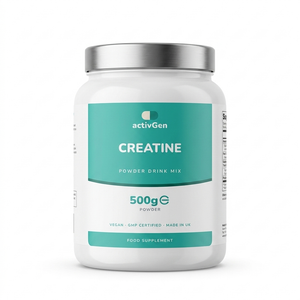
Our Creatine Monohydrate – Unflavoured, 5g Per Serving is a straightforward, unflavoured creatine monohydrate that delivers 5g per serving – comfortably above the 3g a day the evidence points to – with 100 servings per 500g tub for £27.99.

How much creatine should you take, and when?
A simple, well-supported approach is to take 3–5g of creatine monohydrate every day. With our creatine, one 5g serving covers that. You may have read about a ‘loading phase’ (taking around 20g a day split into doses for the first week); it is optional, and many people simply take a steady daily serving instead and let their muscle stores build up over a few weeks.
Timing is not critical, so the best time to take creatine is whenever you will remember it consistently – with breakfast, in your post-workout shake, or alongside your other daily supplements. Consistency over weeks matters far more than the exact minute you take it.
Building a sensible routine around creatine
Creatine is a single tool, not a whole toolbox. If you train regularly, you might pair it with enough protein in your diet – for example a scoop of our Pea Protein in a post-workout shake – and prioritise sleep and rest days. Many active women also keep an eye on magnesium intake; our Magnesium Complex is a popular evening option. And if hair, skin and nails are part of your wellness picture, our Marine Collagen is another option to explore. The point is to build habits you can keep, rather than chasing every new trend at once.
Frequently asked questions about creatine for women
Is creatine safe for women to take?
Creatine monohydrate is one of the most extensively studied supplements on the market and is widely used by both women and men. As with any supplement, if you are pregnant, breastfeeding, taking medication or managing a health condition, speak to your GP or pharmacist before starting. Food supplements are not a substitute for a varied, balanced diet and a healthy lifestyle.
Will creatine make me ‘bulky’?
This is the most common worry we hear, and it is a myth. Some people notice a small increase in body weight in the first few weeks because creatine draws a little extra water into the muscle cells – that is water, not fat, and it is not the same as gaining noticeable size. Building visible muscle takes sustained, progressive training over a long time.
Do I need to take creatine with food or a special drink?
No. You can mix unflavoured creatine into water, juice, a smoothie or a protein shake – whatever you enjoy and will stick with. There is no need for sugary ‘transport’ drinks.
Do I have to ‘cycle’ on and off creatine?
There is no need to cycle creatine. A consistent daily serving is the simplest approach, and you can keep taking it as part of your routine for as long as it suits you.
How long until creatine ‘works’?
If you skip a loading phase, it typically takes a few weeks of consistent daily use for your muscle creatine stores to build up. Patience and consistency are the main ingredients here.
Does creatine cause hair loss in women?
There is no good evidence that it does. The worry traces back to a single small 2009 study in men that measured a hormone, not hair – and the first trial to test hair directly, in 2025, found no effect. We have covered it in full in our guide to whether creatine causes hair loss.
Ready to start? Explore our unflavoured creatine monohydrate – 5g per serving, 100 servings per tub, GMP certified and made in the UK.
This article is for general information and education only. It is not medical advice. Food supplements should not be used as a substitute for a varied, balanced diet and a healthy lifestyle.