
Does Creatine Cause Hair Loss? What the Science Says
You've read that creatine is worth taking, added it to your basket, and then someone in a forum swore it thinned their hair. Now it's sitting in your cart unbought. It's one of the most common worries people have before starting, so let's deal with it properly: does creatine cause hair loss?
The short version — the current evidence does not show that creatine causes hair loss. The concern comes from a single indirect finding from 2009, and the first study to test hair directly, published in 2025, found nothing. Here's where the myth started, what the research actually says, and the one situation where it's still worth a conversation with your GP.
The short answer
No study has ever shown that creatine causes hair to fall out. The worry is built on a chain of assumptions rather than direct evidence. When researchers finally measured hair follicle health head-on in a controlled trial, they found no difference between people taking creatine and people taking a placebo.
That doesn't mean "impossible for anyone, ever" — no supplement gets that label honestly. But if you've been avoiding creatine purely out of fear for your hairline, the science doesn't back that fear up.
Where the creatine hair loss myth came from
Almost all of it traces back to one small study from 2009. Researchers gave a group of college rugby players creatine for three weeks and measured their hormones. They saw a rise in dihydrotestosterone — DHT — a hormone that plays a role in male-pattern baldness in people who are genetically prone to it.
Here's the leap that turned into a myth: DHT is linked to hair loss, creatine appeared to raise DHT, therefore creatine must cause hair loss. But that study never actually looked at anyone's hair. It didn't count follicles, didn't measure hair density, and didn't track anything past three weeks. And in the 15-plus years since, no one has reproduced even the DHT finding.
So a real result — a short-term shift in a hormone ratio — got stretched into a conclusion the study was never designed to make.
What the 2025 study actually found
In 2025, researchers ran the study that had been missing all along. Forty-five resistance-trained men aged 18–40 were given either 5g of creatine monohydrate a day or a matching placebo for 12 weeks. This time they measured the thing everyone actually cared about: hair.
They tracked testosterone, free testosterone, DHT, and hair follicle health — density, follicle count and hair thickness — before and after. The result: no significant difference in DHT, in the DHT-to-testosterone ratio, or in any hair measure between the creatine group and the placebo group. The authors described it as the first study to directly assess hair follicle health after creatine supplementation, providing strong evidence against the claim that creatine contributes to hair loss.
It lines up with earlier reviews too. A widely cited 2021 review of the common creatine myths concluded that the evidence does not indicate creatine raises total testosterone, free testosterone, DHT, or causes hair loss.
Does creatine raise DHT?
This is the real crux, because DHT — not creatine — is the hormone with an actual link to male-pattern baldness. The honest answer: the 2009 rugby study is the only one that ever suggested a meaningful DHT rise, and it has never been repeated. The 2025 trial specifically measured DHT over 12 weeks and found no significant change versus placebo.
In other words, the single domino the whole myth depends on — creatine reliably raising DHT — doesn't hold up when it's actually tested.
What actually drives hair loss
If you are thinning, the usual culprits are far more boring than a tub of powder. Male- and female-pattern hair loss is largely down to genetics and your individual sensitivity to DHT — the DHT your body already makes, with or without creatine. Age, stress, thyroid issues, iron levels and diet all play their part too.
Creatine simply isn't on that list in any evidenced way. Blaming the supplement is tempting because it's the thing you added recently — but correlation in a gym bag isn't causation.
What if it already runs in my family?
This is the one fair caveat, and it's worth being straight about. The 2025 trial was solid but not enormous — 45 men — and it excluded people already diagnosed with a hair-loss disorder. It also didn't measure DHT activity at the scalp itself, which is where pattern baldness actually happens.
So if you have a strong family history of male-pattern baldness, or you're already noticing thinning, the current research doesn't specifically rule out an edge case for you. It doesn't show creatine as the cause either. If you fall into that group and you're anxious about it, that's a reasonable thing to raise with your GP or a dermatologist before starting — not a reason for everyone else to skip creatine.
Does creatine cause hair loss in women?
There's even less to worry about here, and even less research pointing the finger. The entire hair-loss theory hangs on DHT and male-pattern baldness, and the one suggestive study was in young men. There's no good evidence that creatine causes hair loss in women. Female-pattern hair thinning has its own drivers — hormones, iron status, thyroid, genetics — that have nothing to do with a scoop of creatine.
If you want the wider picture on creatine for women, we've covered it separately in what creatine actually does for women.
Frequently asked questions
Will 5g of creatine a day increase DHT?
5g a day is the exact dose used in the 2025 trial, and it produced no significant change in DHT or the DHT-to-testosterone ratio over 12 weeks. It's also the standard daily maintenance dose most people take.
Can stopping creatine reverse hair shedding?
Since the evidence doesn't tie creatine to hair loss in the first place, there's usually nothing to reverse. If you noticed shedding after starting and it's genuinely bothering you, stopping for a couple of months will quickly tell you whether creatine had anything to do with it — most people find it didn't.
How fast would creatine cause hair loss, if it did?
The premise here is the myth itself. There's no established timeline because there's no established effect. Real pattern hair loss develops gradually over years and is driven by genetics, not by a supplement started a few weeks ago.
Is creatine good for your hair?
No — and be wary of anyone claiming it is. There's no evidence creatine helps hair either. The accurate, unglamorous takeaway is that it appears to do nothing to your hair in either direction.
What are the common downsides of creatine?
The most reported one is a small, temporary gain in water weight when you start, as your muscles hold a little more fluid. Some people get mild stomach discomfort if they take a large dose on an empty stomach, which splitting the dose usually sorts. Hair loss is not among the effects supported by evidence.
So, should the hair worry stop you?
On the evidence we have, no. The creatine-and-hair-loss link is a 15-year-old game of telephone that started with one small study measuring a hormone, not hair — and the first trial to test hair directly came back clean. The sensible exception is a strong genetic predisposition to pattern baldness, where a quick word with a professional makes sense.
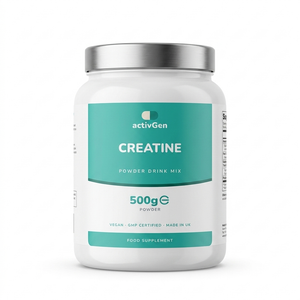
If you've decided to give it a go, a plain creatine monohydrate at the standard 5g dose is all most people need — no loading phase, no flavour, no fuss. Ours is a straightforward unflavoured creatine monohydrate at 5g per serving, and because it's synthesised rather than animal-derived, it's suitable for vegans. If your worry was weight rather than hair, we've also written about what creatine really does to the scales.
You can read the 2025 trial in full via PubMed or the Journal of the International Society of Sports Nutrition, and Cleveland Clinic has a plain-English overview if you'd like a second source.
This article is for general information and education only and is not medical advice. Food supplements should not be used as a substitute for a varied, balanced diet and a healthy lifestyle.